The Apollo 11
Moonwalk
And how you, too, can measure the distance
from the Earth to the Moon and in the
comfort of your own home!
(Click on the image to zoom in.)
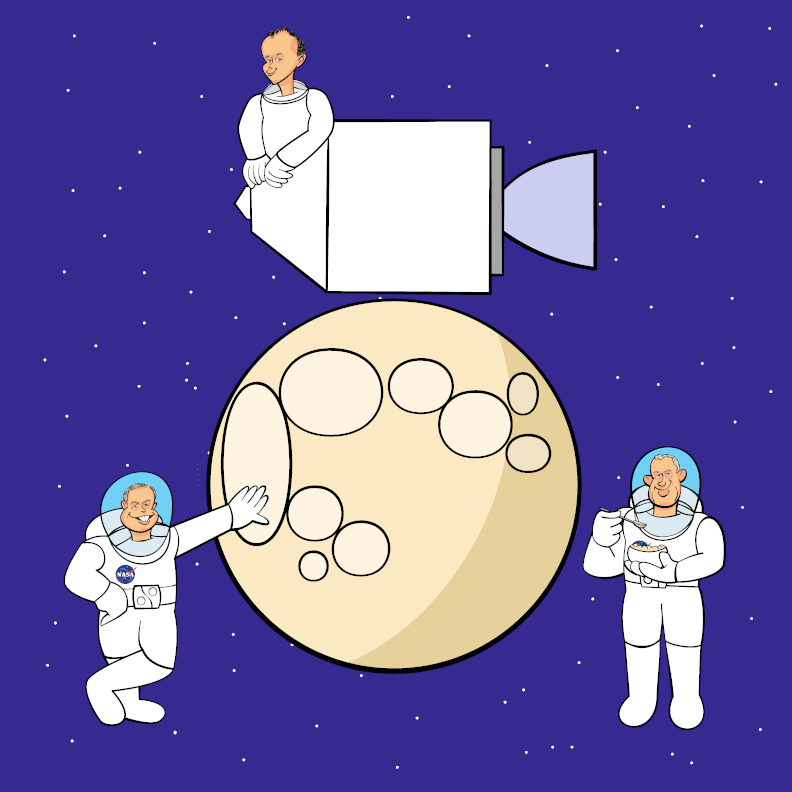
| Capsule Communicator (CAPCOM) Bruce McCandless: | In sports, the Houston Oilers are showing plenty of enthusiasm in their early pre-season workouts at Kerrville, and Coach Wally Lemm says he is impressed with the fine group of rookies. National League baseball for yesterday, Thursday: St. Louis 11, Philadelphia 3; Montreal 5, over Pittsburg 4; Atlanta 12, Cincinnati 2; San Francisco 14, and Los Angeles 13. American League: we have Baltimore 3, over Cleveland 2; Detroit 4 to Washington's 3; Minnesota 8 to Chicago 5. Boston at New York was rained out. And in Corby, England, an Irishman, John Coyle has won the world's porridge eating championship by consuming 23 bowls of instant oatmeal in a 10-minute time limit from a field of 35 other competitors. Over. |
| Neil Armstrong: | Roger. I assume Houston didn't play yesterday. |
| Bruce: | That's correct. |
| Michael Collins: | I'd like to enter Aldrin in the oatmeal eating contest next time. |
| Bruce: | Is he pretty good at that? |
| Michael: | He's doing his share up here. |
| Bruce: | Let's see. You all just finished a meal not long ago, too, didn't you? |
| Edwin "Buzz" Aldrin Jr.: | I'm still eating. |
| Michael: | He's on his 19th bowl. |
- NASA CapCom-CSM Transmission, July 18, 2026. |
|
The Apollo 11 Mission had a number of firsts beyond the amount of oatmeal consumed in outer space. Of course, the most notable accomplishment was when at 2:56:15 A. M. Greenwich Mean Time on July 21, 1969,1 Neil Armstrong stepped down from the last rung of the ladder of the Lunar Module and took his famous One Giant Leap for Mankind.2
Footnote
Of course, the curmudgeons will haughtily point out that popular informational references state that Neil first set foot on the Moon at 9:56:15 p. m. July 20, 1969. That, of course, is CENTRAL STANDARD TIME in the UNITED STATES. That's HOUSTON's time where Mission Control was.
Footnote
Today everyone knows that Neil slightly misspoke in his famous quote. What he said was "That's one small step for man; one giant leap for Mankind." What he meant to say was "That's one small step for A man; one giant leap for Mankind."
But of course the First Step on the Moon required the first Moon Landing. That was 8:17 PM July 20, 1969, Greenwich Mean Time when Edwin Eugene "Buzz" Aldrin set the Lunar Module down on the lunar surface in the Sea of Tranquility.
And of course, someone had to make sure the Lunar Module had a place to return to so the crew could get back to Earth. Holding down the fort3 was Michael Collins who was the commander of the Apollo 11 Command and Service Module (CSM) and - in an accomplishment that is often overlooked - was the first man to grow a mustache in interplanetary space.
Footnote
British critics have pointed out that "holding down the fort" is an Americanism of "holding the fort". "Holding down the fort" implies the fort may end up floating away. But as Michael was orbiting the Moon at a height of about ten miles he was actually holding up the fort..
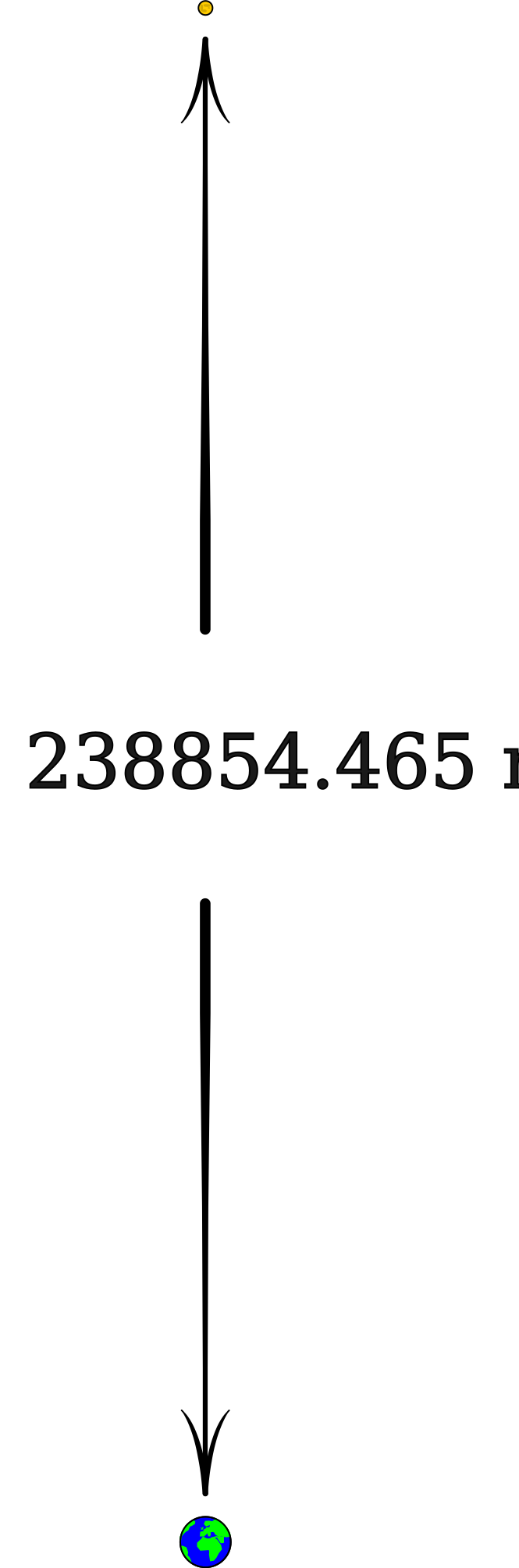
Earth to the Moon
(To scale, sort of.)
But - and it's a big "but" - during the Moonwalk Neil and Buzz and Michael made another first. For the first time in history they made it possible for the average Joe and Josephine Blow to measure the distance from the Earth to the Moon - a distance which popular informational reference works state is 238854.456 miles (or thereabouts). But best of all, the distance can be measured in the comfort of their own home.
Ha? (To quote Shakespeare.) We know Neil and Buzz set up a mirror where the astronomers on Earth could bounce a laser beam to and from the Moon and so measure the lunar distance to within centimeters. But doing that sort of stuff requires specialist equipment and high technology. Not something you'd have - quote - "in the comfort of your own home" - unquote.
And there are curmudgeons who pooh-pooh that measuring the Earth-to-Moon distance by ordinary citizens is anything new. After all, figuring how to measure the Earth-Moon distance goes back Millennia. The methodology was worked out by Aristarchus of Samos around 300 BC. So what's the big deal?
Aristarchus of Samos
Rather Involved
Well, yes, the equipment needed for Aristarchus's method is fairly rudimentary. But the measurements and technique are rather involved and in the hands of the amateur astronomer the numbers might come out disappointingly approximate. And in any case you have to go outside at night to do the measuring and so this isn't really something that's done in the comfort of your own home.
OK. So what do you do?
Remember that the Apollo 11 Moon Walk was broadcast on live television which most people DO watch in the comfort of their own home. The video tape of the Moon Walk was preserved and is now readily available as electronic digital files. The files can be viewed and heard by the courtesy of the National Aeronautics and Space Administration (NASA) which - an oddity today - requires no login or any subscription fee.
OK. We have a video of the Moon Walk. But how does that get us the distance from the Earth to the Moon - quote - "in the comfort of your own home" - unquote?
Well, here's the trick. And the principals are not a lot different from the now famous Lunar Laser Ranging Experiments where you send a beam of light to the moon and count how long it takes to bounce back.
The careful listener will note that in some transmissions after Mission Control speaks to Neil and Buzz the words can be heard a second time, although faintly and after a delay. This may seem a bit strange until you recognize that this phenomenon came about from the headgear the astronauts wore.
Among the standard accoutrements of the astronauts are the "Snoopy caps".4 Officially called the Communications Carrier Assembly, the cap has earflaps holding the radio receiver next to the astronaut's ears and two transmitters were positioned just on either side of the astronauts mouth.
Footnote
The name "Snoopy cap" was from the resemblance of the World War I flyers' caps that was sometimes worn by Snoopy from the comic strip Peanuts. Snoopy was the pet beagle owned by the main character, Charlie Brown, and Snoopy liked to pretend he was involved in various occupations. One of his most popular activity - it was actually the inspiration for a hit Rock and Roll song - was to imagine he was a World War I Allied flyer who was always looking for Germany's infamous Red Baron. During his search for the Red Baron Snoopy always wore the World War I flyer's helmet.
In England such a cap would be called a "Biggles" cap after the main character in a series of popular books written for boys. In the earliest books Biggles was a World War I flyer.
The Snoopy caps were not tight fitting and the words received would sometimes be picked up by the cap's microphone. The words would then be rebroadcast back to Earth. The system used was a Voice Activated Key (called VOX) and sometimes world and phrases could be lost. But in many cases the transmission and the retransmission could be clearly heard and separated by a noticeable time gap.
The time gap was in fact the time needed for the radio wave to make a round trip from the Earth to the Moon and back. So one-half of the interval is the time it took for electromagnetic radiation to travel from the Earth to the Moon. Since the speed of electromagnetic radiation is the same as the speed of light which is known to high accuracy and precision - and in fact is now a defined constant - the distance to the Moon can be easily calculated.
Nothing simpler.
Well, if it's so simple, then enlighten us, please.
OK. One particularly clear instance of the transmission and retransmission is when the flight surgeon, Dr. William Carpentier, noted that Neil's heart rate was getting a bit up and said they should ask him to slow down and take a rest. Rather than just have him stand around and do nothing, the capsule communicator (CAPCOM) Bruce McCandless (also an astronaut) asked Neil to run a check on his EMU (Extravehicular Mobility Unit - ergo, his spacesuit).
So Bruce radioed up to Neil:
"Neil, this is Houston, Request an EMU check. Over."
Now by taking this clip and plopping it into an audio editor5 you can see the waveform intensity spectrum and easily identify the individual words:
Footnote
A number of these programs are available. Here the Audio Ocean program was used.
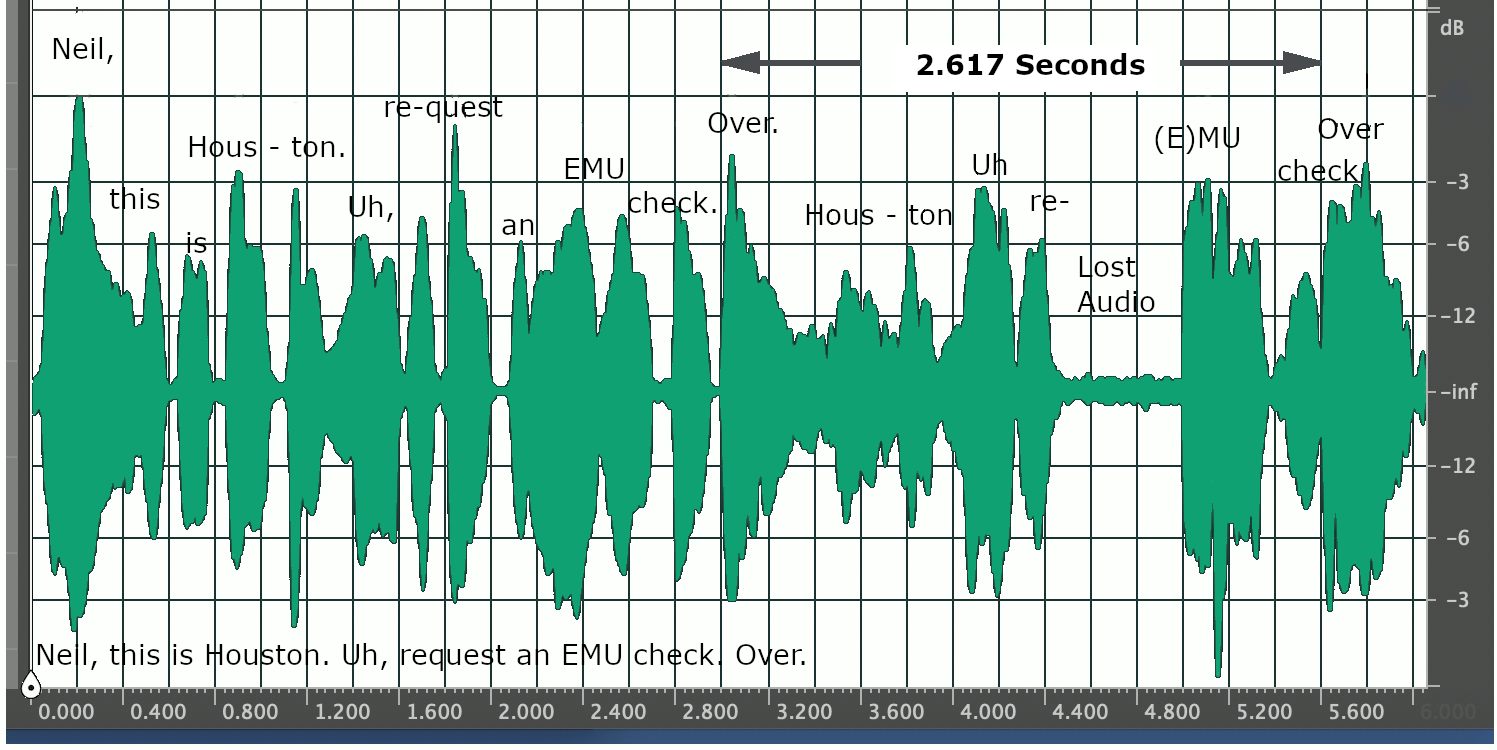
"Neil, this is Houston. Uh, request an EMU check. Over."
Audio Intensity Waveform
(Click on image to open in an expandable window.)
Any of the repeated words can be used. In this case we select the word "Over" by zooming in on the waveforms for the word (both transmission and return). It's quite simple to locate the time where the word begins simply by looking at the point where the signal rises above the baseline.
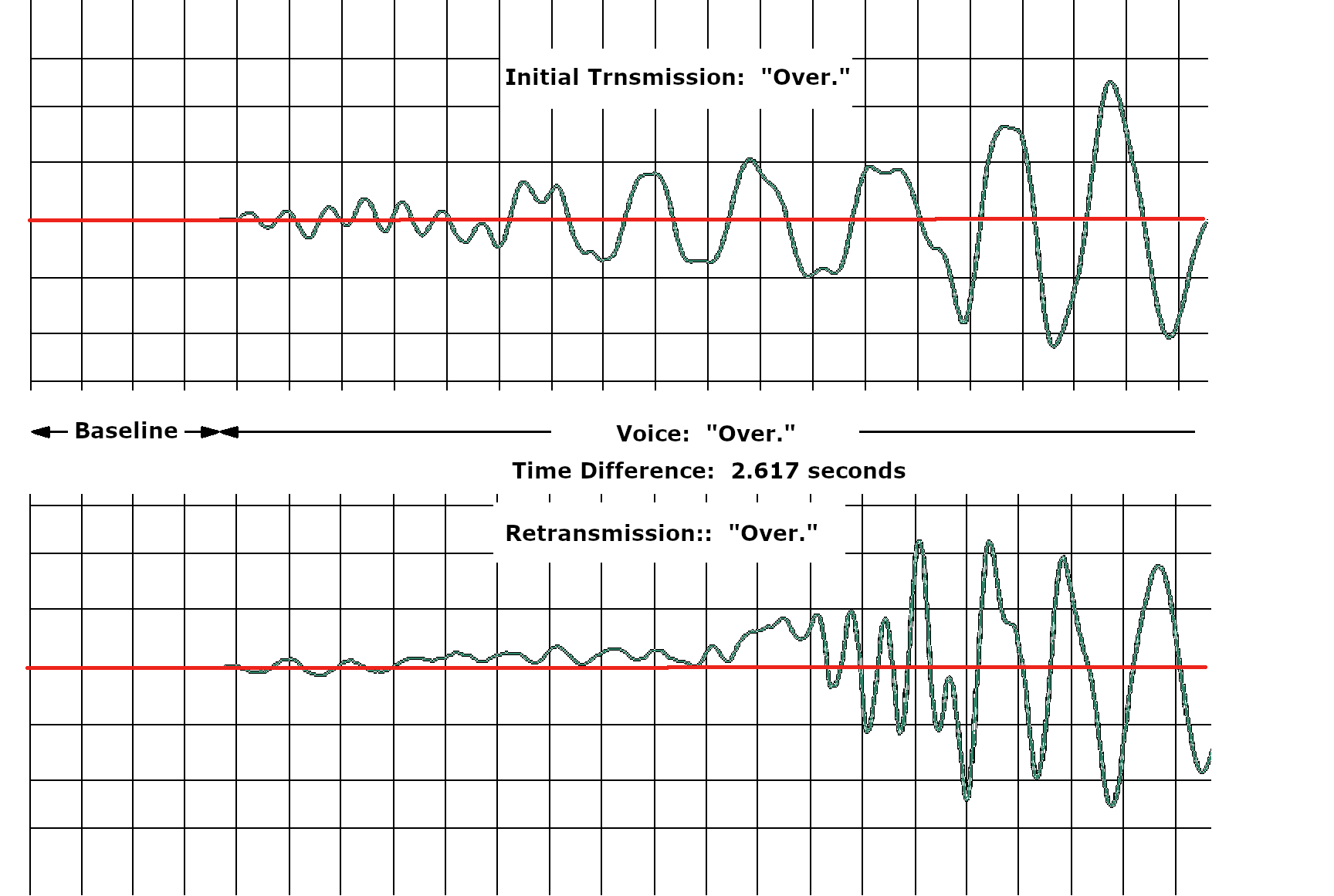
""Over" Initial and Return Transmission"
Audio Intensity Waveform
Then by using the cursor to identify the exact time of transmission and retransmission you can get the time interval between the words:
Time (Return) - Time (Initial) = 2.617 seconds
So the time for the radio waves to get from the Earth to the Moon is half that time:
Time (Earth to Moon): 2.617/2 = 1.3085 seconds
Now the speed of light is EXACTLY 299,792,458 meters per second.6 So it follows immediately that based on the audio transmission and the delay, the Earth-Moon distance is:
Footnote
The exact speed of light is known by a somewhat circular definition and is based on the length of the meter and the second. These definitions changed after the turn of the Millennium from the classical definitions.
Originally the meter was defined by the length of a stick in Paris, but such a measurement has no real meaning as the length varies with temperature, humidity, and velocity. If you get down to the atomic level it means even less as the atomic particles are probability densities and there is a finite probability that one of the electrons at the end of the stick is actually on the planet Mars.
The second had undergone all sorts of definitions. Finally in 1960 the second was defined as - get this - 1/31,556,925.9747 of the tropical year in 1900. However, even this was soon deemed inadequate, and in 1967 the second was defined based on light emitted by the Cesium atom.
The Cesium atom has an electronic configuration of 1s2 2s2 2p6 3s2 3p6 4s2 3d10 4p6 5s2 4d10 5p6 6s1 which means it has only one electron in it's outermost orbital. But this electron has what scientists call hyperfine splitting which means the electron generates two different energy levels where normally the energies would be equal. With only one electron in the orbital it can have spin of either +½ or -½. These two electronic states would normally have equal energy but because the electronic spin is affected by the spin of the nucleus, the two electronic states aren't the same.
When electrons go from one state to another they absorb or emit radiation - "light" in the general parlance - and light has a frequency. The frequency of a light beam is just how fast its electromagnetic field wiggles back and forth - "oscillates" in fancy scientific language. In this case the second is defined as the time it takes for the light from this Cesium hyperfine transition to undergo 9,192,631,770 oscillations - that is cycles per seconds or hertz (hz).
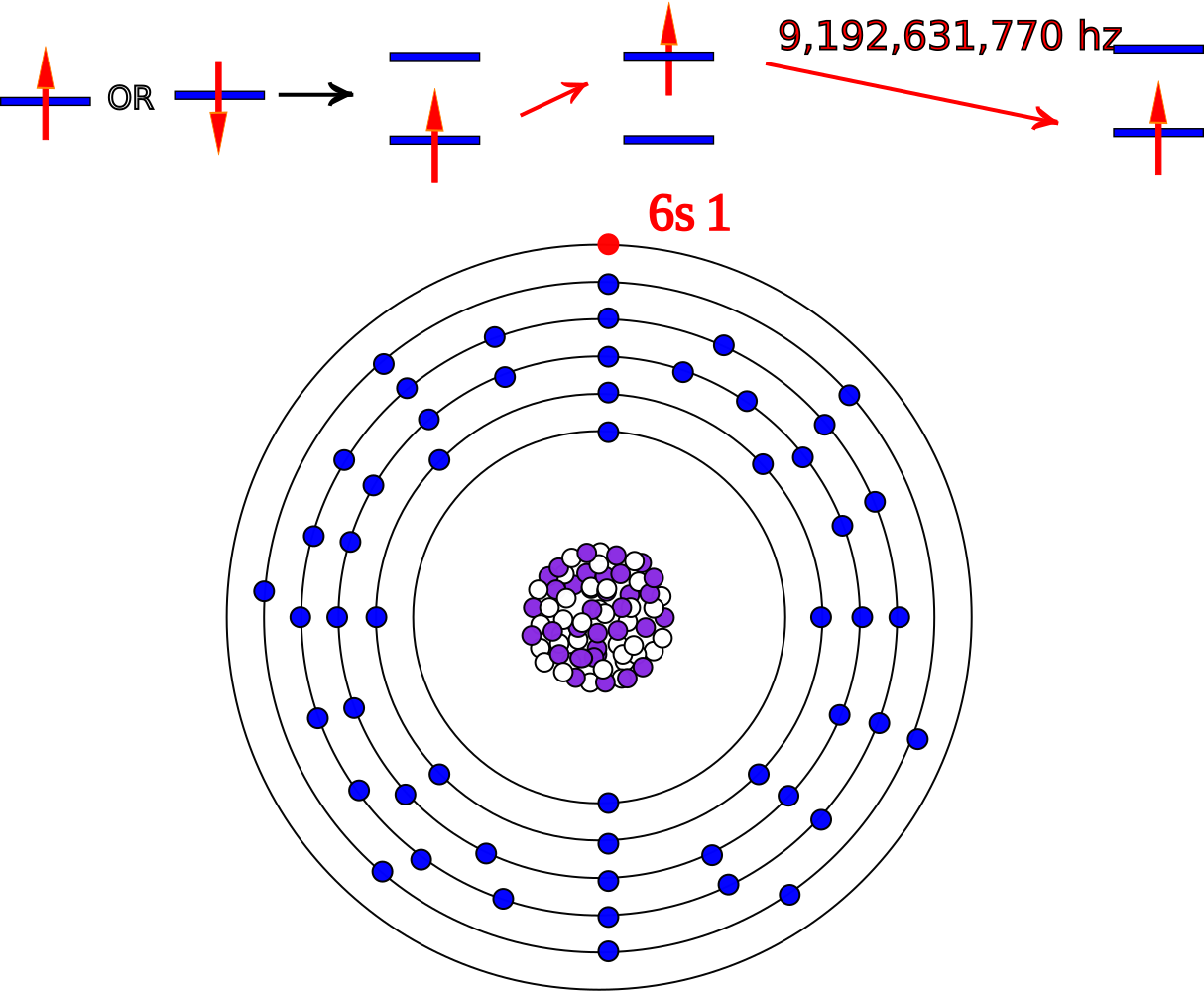
Cesium 133 Hyperfine Second
So what you can do is send microwabes to the cesium atom. Then at some point a microwave with a frequency of 9,192,631,770 hertz will hit the lower energy electron and boost it up to the upper level. Then when the electron falls back to the lower energy the atom emits the light of the same frequency which can be detected.
So rather than try to measure the second based on the length of day or the year, you just define it as:
1 second = 9,192,631,770 hz from Cs-133.
Since frequencies are a bit abstract for a lot of Joe and Josephines Blows on the street, you can use the wavelengths of light - represented by the Greek letter lambda, λ which is calculated from the equation:
λ (cm) = 29979245800/Frequency (Hz)
So the wavelength of the Cesium hyperfine transition is:
λ (cm) = 29979245800 m-sec-1/9192631779 cycles-sec-1
Which is EXACTLY:
λ (cm) = 334305007 /131323311 centimeters
This means that if you watch the light go by and count the wavelengths once you see 9192631779 of the wavelengths pass by that's one second.
OK. So we now know what the second is, we can define the meter.
The meter is defined as the distance that light travels in 1/299,792,458 of a second in a vacuum. So that means the speed of light - which everyone knows is represented by c - is:
c = 299,792,458 meters/second
What is interesting is that because the inch is now defined - again EXACTLY - as 2.54 centimeters and we know how many inches per feet and feet per mile, we know EXACTLY the speed of light in Good Old Fashioned English Units. And that's:
186282 miles 2096 feet 5 21/50 inches per hour
The proof of this - as the mathematics textbooks say - will be left as an exercise for the reader.
299,792,458 meters/second × 1.3085 seconds = 392,278,431.293 meters
Or in more American-friendly units:
| 392,278,431.293 m × 100) 2.54 cm/inch x 12 in/ft x 5280 ft/mi |
= | 243,740.517 miles |
Now a fundamental principle of science is a single calculation does not a definitive measurement make. Furthermore, those who have taken middle school math will know that not all of the digits in the calculated distance are significant. They also know that the number of significant digits is limited by the number used in the calculations that has the fewest number of significant digits.
But since the speed of light is known exactly - all digits are significant - the number of significant figures is limited by the accuracy and precision of the time measurement. The time in the audio recording is known to 0.001 seconds and as the time length is between 2 and 3 seconds, the limit of significant digits in the calculation is 4.
But that doesn't mean the final distance will be known to four significant digits. There are other sources of error. These include things like how well the audio reproduces the original transmission speed and variability in pinpointing the beginning of the words that define the Earth-to-Moon time interval.
To determine the true uncertainty you need to make repeat measurements or replicates. The measurements can't just be repeated calculations for the same audio clip. Instead different phrases need to be selected and then from the differences, you can calculate the standard deviation of the times and from this you get confidence intervals. According to statisticians the average value of the measurements is the best estimate of the true value and the confidence intervals tells you where the true value falls between two numbers within a given probability.
Fortunately if you listen to the whole audio of the Moon Walk, there are a number of other places where the retransmitted words can be heard and the time difference measured. A selection of the words is given in the table below along together with the calculated Earth-Moon distances. From these distances comes the average and the 95% confidence interval.
| Word | Time Difference (sec) | Distance (miles) |
|---|---|---|
| "Over" | 1.3085 | 243751 |
| "Check" | 1.3250 | 246824 |
| "Houston" | 1.3245 | 246731 |
| "This" | 1.3140 | 244775 |
| "Houston" | 1.3555 | 252506 |
| "Reading" | 1.3300 | 247756 |
| "Say" | 1.3005 | 242260 |
| "Columbia" | 1.3275 | 247290 |
| "Columbia" | 1.3195 | 245800 |
| "Copy" | 1.3190 | 245706 |
| Average: | 246340 | |
| 95% Confidence: | +/-1701 (0.7%) |
So skipping the statistical mumbo-jumbo, this means that we can be 95% confident that the TRUE VALUE of the distance from the Earth to the Moon is between 244639 miles and 248041 miles.
But ... but .... but.... According to popular informational references the distance from the Earth to the Moon is 238854.465 miles. And this supposedly true value is OUTSIDE the confidence interval of our data. In fact the difference between the calculated and reported value is over 7000 miles! That's over 3% error! Too much!
Have we failed?
Weeeehhhhhheeeeeellllll, not quite.
Remember the Moon travels around the Earth in an ellipse. The closest distance - the perigee - is 224,000 miles and the furthest distance - the apogee - is 251,655 miles. So the question should be How High the Moon when Neil and Buzz were walking on the Moon?
Well, the value reported for the Earth to Moon distance on July 20, 1969 is 244930 miles. So things look better since that's only 0.6% error from our measurement - a five fold improvement. But most importantly, the "real" value does fall within our calculated uncertainty limits of 244639 miles and 248041 miles.
At this point it's tempting to declare success. But a little mature reflection tells us we can go a bit further.
Remember the official distance of the Earth to the Moon is from their centers of mass. But Houston and the astronauts were on the surfaces. So measuring the distance by the time delay is not really measuring the true astronomical distance. Fortunately a correction for "real" distance can be finagled.
The Moon Walk began at 9:30 p. m. Houston Time on July 20, 1969. At this point the Moon was a waxing crescent. That means it was moving toward the night side of the Earth. Of course at 9:30 p. m. it was nighttime in Houston but the Moon was not visible in the sky. So there was no direct line of radio transmission from the astronauts to Mission Control.
Instead the radio transmission went from the Sea of Tranquility to a receiver in California and then the signal was sent on to Houston. As can be seen from the drawing below - not to scale - it looks like the distance of the transmitted signal is actually longer than the official center-to-center Earth-Moon distance..
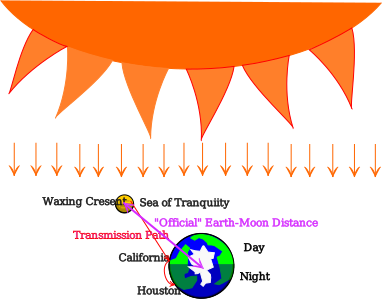
Transmission - Earth to Moon Distance
To get a real handle on the correction needed, you need to make a diagram where the sizes of the Earth and Moon and the distance of separation is to scale. Surprisingly this isn't too hard to do since here are plenty (and free) graphics software you can use to draw the Earth-Moon system in the proper propotions.
And once everything is scaled properly, you find that the distance traveled by the radio transmission is about 0.76% longer than the distance from the two centers. So the distance calculated from the time intervals should be reduced by that amount which turns out to be 1864 miles. So the final Earth-Moon distance - center-to-center - is:
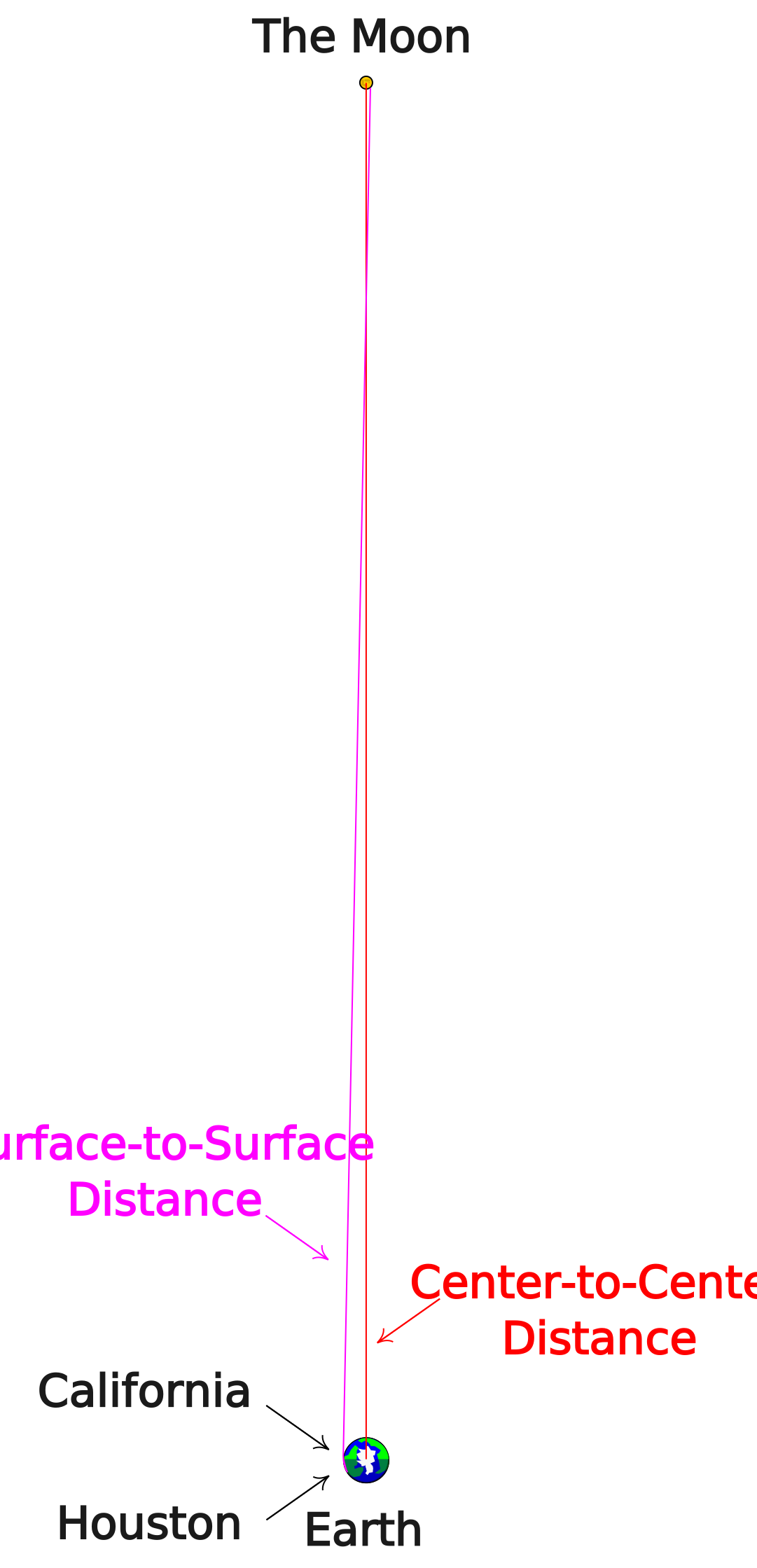
Corrections
Centers to Surfaces
(Click to Open in an Expandable Window.)
246340 - 1864 = 244760 miles
And with the "real" value of 244930 miles, the error is a scant:
244930 - 244760 = 170 miles
Which is only 0.07% error!
Not bad from the comfort of your own home.
References and Further Reading
"8 Days: To the Moon and Back", BBC Two, British Broadcasting Corporation, July 5, 2019.
"The Apollo Lunar Surface Journal and Apollo Flight Journal", NASA.
"Day 3, Part 1: Viewing Africa and Breakfast", David Woods Apollo Flight Journal (Redirect from NASA).
"Apollo 11 Moonwalk", NASA.
"How We Saw Armstrong's First Steps", Jennifer Levasseur, National Air and Space Museum, July 8, 2019.
"Want to Measure the Distance to the Moon Yourself? Now You Can!", Shannon Hall, Universe Today, May 27, 2014.
"Laser Ranging at Interplanetary Distances", G. A. Neumann, J. F. Cavanaugh, D. B. Coyle, J. McGarry, D. E. Smith, X. Sun, M. Torrence, T. W. Zagwodski, and M. T. Zuber, International Laser Ranging Service, NASA, 2006.
"Dear America", David Mitchell (presenter), David Mitchell's Soapbox, May 20, 2010.